
Time for Can
Situation
When I joined Parkinson’s UK, a brand-awareness TV campaign (Time for Can) was already in production. The ad challenged the perception that people with Parkinson’s are defined by what they can’t do (can’t sleep, can’t eat, can’t work) contrasting with what the charity can do (can help, can research, can fund, can fight). Stark and powerful, it delivered shock and cut-through using existing footage.
However, it sat in isolation. There was no integrated campaign, no digital or content presence, no link to policy or campaigns activity, and no alignment with the Christmas direct mail appeal—representing a major missed opportunity. There were also no plans to scale the idea. Compounding this, community pre-testing was split: some welcomed the impact; others felt it was too close to the bone.
Task
My insight was that if Time for Can was to become a true brand positioning, it needed to be made bigger and brought to life properly. We had to bring the community with us through a soft launch and clear explanation of why impact mattered; add depth by grounding the creative in lived experience; and embed the CAN narrative consistently across everything the organisation said and did—from policy and campaigns to events and appeals.
Action
I built a fully integrated campaign around the TV ad and pre-launched it to the Parkinson’s community.
At its heart were the real stories of the people featured in the ad. I conducted and filmed seven in-depth interviews, released across social and forming the backbone of paid and organic activity. I led a full digital takeover of the website (homepage and landing pages), supported by content, email, and PR explaining why the creative needed to be hard-hitting.
The campaign explicitly reframed each individual CAN’T (can’t sleep, can’t eat) into their own CAN. It was delivered entirely in-house by my team and launched in time for Christmas. The film ‘Can’t Eat’ kicked things off in the community and got 60k views on the day it launched.
To extend the brand platform into fundraising, we filmed two additional interviews—one with a researcher and one with a research participant (CAN HELP)—bringing the idea into the Christmas direct mail appeal. I then reached out to the policy and campaigns teams to apply the platform to key issues: access to care (CAN’T WAIT – see separate case study), access to medication (CAN’T DO WITHOUT DRUGS), and mental health (CAN’T GIVE IN).
Results
This became the most comprehensive integrated campaign the charity had ever delivered, aligning brand, digital, social, PR, policy, and the Q4 direct mail appeal.
Brand awareness and condition understanding significantly exceeded targets. Christmas appeal donations were the highest on record, online conversion rates almost doubled, and organic sharing was more than 10x the charity norm. TV brand metrics showed the creative outperformed charity benchmarks across all brand statements. Most importantly, members of the community felt they could share it.
Second Outing
For the second outing we needed to make some adjustments to the ad and switch out some case studies. I refined the script to strengthen the CAN message and led the filming of new content, creating a revised 30-second TVC (see below) and four new 10-second executions. These ran across TV, paid digital, and digital billboards to extend reach and maximise budget efficiency.
Nationwide digital out-of-home followed, including Transvision across all major UK train stations. £250k of media was donated by Smart Outdoors to support the campaign.


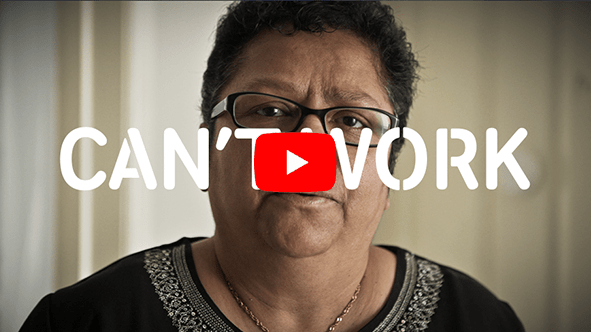
The 30 second TV ad. 10 second versions extended the campaign.
The campaign ran over outdoor, using digital poster sites across the UK. I developed digital boards using shorter cutdowns including transvision in all major train stations across the nation. These were a combination of static and 6 second clips, in various formats.


A selection of the 9 longer form videos. I interviewed the people and directed the filming and edits.